
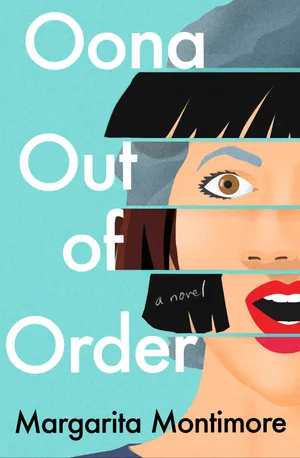
Oona, Oona – how you made me cry! Going into this book, I never would have thought it would be one I would shed tears over, but I did. That’s a rare feat. I can list the number of books that have made me cry in my lifetime. Generally, the only things that make me cry involve sad stories about animals and, knowing this, I avoid them like the plague. Or the coronavirus.
Let’s see…
- Charlotte’s Web by E.B. White
- Me and Caleb by Franklyn E. Meyer
- Little House On the Prairie by Laura Ingalls Wilder
- Black Beauty by Anna Sewell
- Gone With the Wind by Margaret Mitchell
It’s a short list. I’m too jaded to cry over most things. Oona Out of Order snuck up on me, though. It presents itself as a typical chick lit book, frothy and light where you might get some quirky comedy, a little romance, and call it a night. However, Oona is deceptive, and ends up offering the reader all of that and so much more.
To give you a quick peek at the plot, Oona Lockhart is about to turn 19 years old. We start our story with her on New Year’s Eve, 1982. Her birthday is New Year’s Day. She’s celebrating with her boyfriend and their bandmates and friends at a party, drinking too much and having a great time, excited about the possibilities stretching out ahead of her. As the clock strikes midnight, Oona feels a little funky and blacks out, only to wake up in a strange home with a guy named Kenzie standing over her, and her 19-year-old mind in the body of a 51-year-old woman. Oona’s 51-year-old body, to be exact. While Oona’s mind has remained it’s current age, she has jumped forward in time to inhabit the body and life of a later version of herself. Kenzie, her personal assistant, and Oona’s mom are the only two people aware of Oona’s condition and they talk her through it. Turns out, Oona does this every year at midnight, jumping around to different years of her life while remaining her same self mentally.
Sound confusing? It is, a little. It took me about a fourth of the way into the book to wrap my mind around the concept. Let me go through it again. (Maybe I’ll get it this time!) You see, we’re meeting Oona at her first time jump, and the mechanics of it have yet to unfold for her. While Oona stays mentally chronological from year to year, her physical life does not – she jumps around continually but only once to each year of her life (after the age of 19 – no childhood perspectives). However, for her loved ones, Oona’s physical life moves forward in a linear fashion and each year they are interacting with Oona at a different age mentally. In the first jump at 19, Oona (and the reader) have no idea what’s happened or how it all works. However, after this first jump, Oona and her later versions of herself remember quite well what happens moving forward and she leaves herself a letter each year, hinting at this or that but not revealing everything that will unfold. Oona’s mother is under strict instructions not to disclose anything to Oona, either. The joys and the heartaches of life are still somewhat left for Oona to unravel in their own time.
My advice to you is not to focus too much on the mechanics of the time travel. I still can’t say it makes exact sense and it’s never explained why this happens to her, but the mechanics aren’t the main focus of the story. Also, Oona has no need to worry about money – she keeps a detailed notebook available to herself from year to year that lists stocks to buy and sell, so she’s stupid rich. It’s a convenient ploy for the plot, but, again, don’t focus too much on that. We get the messy bits out of the way that would lead to too many questions about how she holds down a job with her strange condition. Just accept that she jumps through time and has plenty of money, and you’ll enjoy the book much more than you would if it were bogged down with those details.
That’s not to say that the rest of the book doesn’t have plot points that make me scratch my head. I might read it again now that I know the story, and follow the letters she writes to herself more closely. It seems that sometimes she put things in the letters that she shouldn’t already be familiar with, or she’s made decisions in a previous year that were out of character for the Oona we’ve come to know. Also, she occasionally fights with her mother, for example, and her mother is still mad at her on her birthday but she knows Oona will not be the same person she was the day before (time jump, duh!) so why is she mad and not speaking to her? Little things crop up here and there and might fall into place on a second read. Again, not the main point of the story but it’s distracting.
What I really want to talk about is the overall plot. It may sound like I didn’t like Oona, but I truly, truly did. The most fascinating part to me was the amount of reflection I did on my own life while I was reading this book. I mean, imagine yourself as a 19-year-old jumping into the year you’re living now. Would your teenage self recognize you? Would she or he understand the people in your life or the compromises you’ve learned to live with? Would your 19-year-old self feel like you’ve spent your time on worthwhile pursuits and built the life you dreamed of in your youth? Would you like yourself as you jumped from year to year in a broken timeline and saw the people and places and choices you’ve made? Maybe. Maybe not. I’m certainly not living the life I thought I would when I was a teenager. It’s not a bad life, but it’s not what I planned on either. Is that a bad thing? Time will tell. Life is hard and strange and beautiful and you make the best decisions you can and only by living that life do you know if you’ve taken the right bend in the road. Choices me make chip away at us in small bits over the years, and we don’t always realize until years later if and where we went wrong. We don’t get second chances and that’s part of the allure of Oona’s story. She does have opportunities to change things, to see what life might offer. However, she’s also seen parts of the past and future, so her choices are often more difficult than yours or mine might be, knowing what she knows of her years she’s experienced. It’s bittersweet to see if she’ll live through what she already knows is a bad decision in order to get to a better decision later on. What would you do? That’s the pervasive question and the part that had me twisted.
The other struggle (and the one that really tore at my heart) is Oona’s relationship with her loved ones. Do any of us ever really feel we have enough time with the people we love? Relationships change, family members grow older, friends fall by the wayside as we change jobs or move or just grow apart – but what if you saw them only through jumping in and out of time? One year, you’re close. The next year, they’re gone. The next year, you see them again. What would that do to your psyche? Time is fleeting enough, but it’s Oona’s inability to really spend those consistent years with those she loves that’s the heartbreaker. She has a year with them, maybe, and no idea what the new year will bring to her. Will she be older? Younger? Where will her loved ones be? Her time with everyone is fleeting in ways they aren’t even aware of – but Oona knows. She’s seen the past and she’s seen the future and she can’t stop time jumps; she can only live her moments as deeply as possible. When you consider it, isn’t that all any of us can do? Those jumps in and out of her loved ones’ lives – that’s what started my waterworks flowing!
Of course, it’s entirely subjective, this crying business. Folks who aren’t that attached to animals could probably care less if the Ingalls family let’s their bulldog get swept down river or a common spider dies a natural death at the county fair. Are you burned by love? Who cares, then, if Rhett leaves Scarlett just when her icy shell thaws and she realizes how tragic their story really is. Hate your family? Then you might not mind Oona’s journey through her life and the heartbreak of a broken timeline with those she holds most dear. It got me, though, and it made me think. Not so much about Oona, but about my own choices, and I’ve resolved to do better by my family and friends thanks to her.
Oona Out of Order was published as The Rearranged Life of Oona Lockhart in the United Kingdom, New Zealand, and Australia. Montimore’s website lists another book she wrote, Asleep from Day, that appears to be a similar theme but I have not read it. Many reviewers have made the obvious comparison between Oona and The Time Traveler’s Wife by Audrey Niffenegger (which, come to think of it, might have also made me shed a tear or two for similar reasons…). Oona is a little more whimsical and sweet, however, and reminded more of Remember Me? by Sophie Kinsella or even the film 50 First Dates starring Drew Barrymore and Adam Sandler. What Alice Forgot by Liane Moriarty (Big Little Lies) has drawn favorable comparisons. There are also some good titles with a time travel theme in this list from Book Riot. If you’re thinking about reading Oona for your book club, this link has some great questions! Finally, here are links to other reviews so you can get additional opinions if you are still on the fence.
At the end of the book, there is a definite sense that Oona’s story could continue. After all, we start out with Oona when she is turning 19 and we are with her chronologically (mentally, at least) until her mid to late 20s. We learn some of the answers to Oona’s questions, but there are many years left to explore. Montimore hints at the possibility of continuing Oona’s story in this interview, but, unlike Oona, we can’t jump around to find the answers – we’ll just have to wait and see how her future unfolds.