
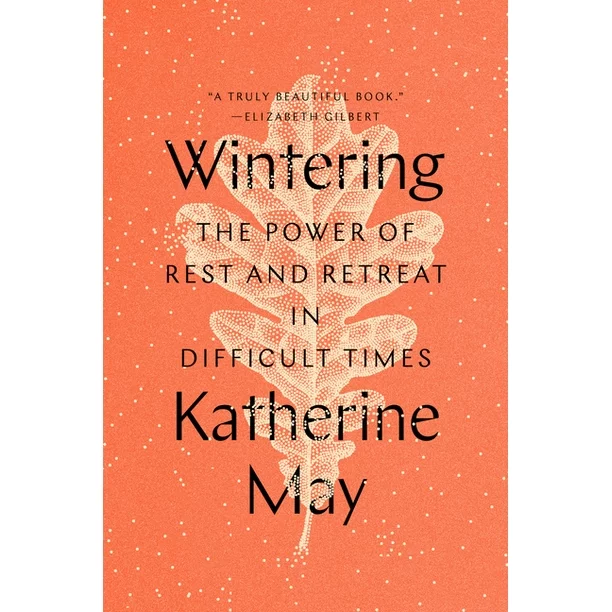
In the midst of a pandemic and quite by accident, author Katherine May has presented the world with a book that guides the reader through winter – not the annual season, but those darker periods of our lives when we are forced to retreat from the unexpected hardships of life that leave us severely bent or even broken. As May writes, “Everybody winters at one time or another. Some winter over and over again. Wintering is a season in the cold. It is a fallow period when you are cut off from the world…” The reasons for personal wintering are numerous; think of the loss of a loved one, the loss of a job, your own illness, a break-up. All are reasons that you might fall off the map for awhile. You surrender to isolation from your normal life, your focus turns inward, and you make preparations to dig in and survive the bleakness surrounding you – your own personal winter has begun.
For May, her most recent winter started around her 40th birthday when her husband fell ill and she had to care for him; then she fell ill and decided to leave a stressful job; then her son was miserable at school and she decided to homeschool him – you see where this is going. Life changed completely for her and she retreated into comforting tasks such as reading, baking, or adult coloring pages that helped her fill the time and find the calm within the quiet pleasures. This time in her life is where the memoir (the term I find most pertinent) starts. May has been through wintering before with previous health challenges in her life (I’ll let you discover those), so she is somewhat prepared for what lies ahead. Through her writing, May shares with us stories from her life but the path she takes us down is by no means direct. The tale meanders quite frequently, much like those blogs where you want the recipe but you have to sift through the blogger’s tedious anecdotes to finally get the goods. Only May’s way of telling it isn’t tedious. In fact, it’s quite enjoyable to go down each rabbit hole with her as she draws in examples of actual (seasonal) winters for comparison to navigating personal winters. Once you realize there is no magic answer (or recipe) to be had, you can relax and enjoy the journey.
May’s overarching point is that wintering is a normal part of life, a time of immense opportunity for positive growth if navigated correctly, and a time for reflection and introspection. Not that getting through a wintering period is ever easy. May herself says, “However it arrives, wintering is usually involuntary, lonely, and deeply painful. Yet, it’s also inevitable.” It’s the inevitability that we can all relate to. May reaches far and wide to pull together examples of and references to winter to illustrate her point and create parallels with human trials. These examples, I have to confess, are my favorite parts of the book. Her personal story is not that uncommon, but she excels when she delves deep in the side journeys. May is a fan of winter as a season and any place that is icy and snowy by default. To paraphrase, ice is good for physical injuries so it should be just as good for the emotional ones.
May recounts trips to Stonehenge for the winter solstice or to the Arctic to see the Northern lights; she delights in polar plunges in the ocean in winter and travels to visit the Sami people and their reindeer in Finland – all journeys to fill an emotional need at the time. Examples in nature of animals and plants preparing for winter abound and May includes wolves, dormice, bees, birds, trees, and even the ants and grasshoppers in her narrative; not just mentions, but whole sections on the behavior and activity of these other livings things as they prepare for and live through actual winters, accounts so fascinating you forget that the book is about human tribulations. About May. And you. And me. The accounts are engrossing and, loving trivial side quests as I do, I could easily fall into an ongoing conversation about all of them. May also draws on literary references such as Sylvia Plath, Philip Pullman, the land of Narnia, and fairytales to showcase winter as a metaphor for dark times that the protagonist has to suffer through in order to get to the story’s happy ending. (Well, not for Plath.) Mythology, sociology, secular mysticism, crafting, Hygge, and psychology also have heavy rotation with May citing studies about a variety of subjects like seasonal affective disorder or the effects of too much light in our current world versus the lack of electricity for our agrarian ancestors during their seasonal winters and how those things parlay into wintering during difficult emotional times for us now.
There is a lot packed into this book. I can imagine Wintering being criticized for romanticizing the difficult periods in our lives and glossing over the realities of lost wages or permanent physical or emotional injuries sustained by whatever caused our involuntary wintering. While May hints here and there that she had financial worries, she also admits to feeling guilty that she enjoys not working during her wintering and being able to spend time in her personal pursuits. It’s not a luxury many of us would relate to if the tables were turned. This is not a Dave Ramsey or Suze Orman tome that will give you a black and white plan on how to prepare for a hardship in the event of job loss or crushing medical bills. Don’t hold that against Wintering; it was never meant to be a workbook. Instead, May’s lesson is that we should not only expect and prepare for wintering, but lean into it and take respite in it as much as we can. Use the down time to rediscover ourselves and what is important to us, rest and surrender and survive until the winter is past.
In the same vein as Eat, Pray, Love by Elizabeth Gilbert, I really enjoyed Wintering. I listened to the audiobook, so the conversational style of the storytelling came across really well. As popular as Eat, Pray, Love was, it was also heavily criticized by some as being self-indulgent. I can see that as a hit Wintering might take as well, but I loved both books nonetheless. I’m a firm believer that books find us when we need them. At another time, I might not have enjoyed it, but I found Eat, Pray, Love when I was at rock bottom and it became transformational for me. Wintering has certainly proven to be the right book at the right time, as well.
A global pandemic is certainly a reason for wintering. May doesn’t directly address the pandemic, but hints in the epilogue to factors that have caused her current wintering period to last longer than she thought it would. Mentioning the COVID-19 crisis outright would certainly date the book and make it appear to be about the pandemic when, in fact, it is not. The timing was providential, of course. May’s book was first published in the United Kingdom in February 2020 (Wintering: How I Learned to Flourish When Life Became Frozen), just before the pandemic took hold. The reviews were positive, with one reviewer describing May’s lovely, descriptive writing as a “reading cure.” Now, with the November 2020 publication date here in the United States, Wintering is especially relevant since the whole world has been wintering together. (I do like the original UK subtitle versus the one used in America – it seems more apt and less self-helpish.)
All in all, I enjoyed the journey of Wintering and it helped me see the positives in my life amidst the devastation of the pandemic. I’m lucky that I have any positives to count because I know many people don’t. This book won’t be for everyone but I hope that it finds you when you need it. Winter does come for us all in the end.
If you want to read more about Katherine May, her website can be found here.
NPR has a recent interview with May here, and Vulture has one here.
If you want to read more books about self care, try these. For books about a personal journey like Wintering or Eat, Pray, Love try these.